We hope all this helps you to try your first yoga class. Enjoy it!
No Mat, No Worries: Just Start Yoga
The best way to start a yoga practice is simply to start. Forget all the worries and concerns you have about not being flexible enough, or having the right equipment. The more we listen to our fears, the easier it is to let them take control.
“The most important pieces of equipment you need for doing yoga are your body and your mind”
Rodney Yee
With lots of yoga teachers putting free sequences on YouTube it couldn’t be easier to start your yoga practice. To get a taste of it maybe search for something like ‘morning yoga’ or ‘bedtime yoga’ online and have a go with what comes up. You don’t need a mat, or special clothes. Just practice on a soft surface in something comfy!
Although online practices are great it’s a good idea, especially for beginners, to go to a public class. Here the teacher will be able to offer any modifications to poses for any injuries you might have, and ensure you’re practising safely and within your limits. There are so many different styles of yoga, and yoga teachers, it’s a good idea to try out a few different classes to find one that feels right for you. If cost is a factor many studios offer community or donation-based classes, so have a look around online to see what you can find.
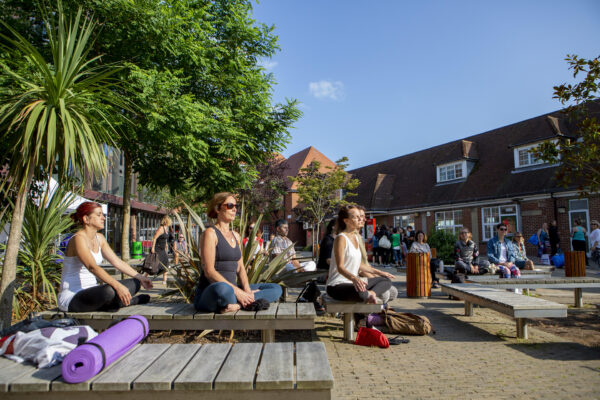


The annual Brighton Yoga Festival is also a great place to start your practice as the classes are generally all free. You can try out lots of different styles and teachers to find the best one for you!
Once you’ve started your practice it can feel really good to add a small daily home practice to your routine. This doesn’t need to be long at all; maybe just a couple of full-body stretches, cat-cows, and neck-rolls in the morning. With yoga a little really does go a long way, and you’ll notice the benefits of this daily practice in no time.
Be practical! Yoga is not always the gentle activity many think it to be (although it can be). It can be very aerobic and it can get hot. If the class has dynamic, hot, power, astanga, or yoga flow in its name, you are going to sweat! Sports-style clothing – leggings, shorts, tracksuit bottoms, vests, fitted t-shirts – is strongly advised.
It’s best not to wear baggy t-shirts as they will get caught up in a posture and will fall over your face, not only dangerously blocking your vision but – especially in an upside-down pose – baring rather a lot.
It’s best not to wear baggy t-shirts as they will get caught up in a posture and will fall over your face, not only dangerously blocking your vision but – especially in an upside-down pose – baring rather a lot.
We don’t wear socks in a yoga class as it could be dangerous. Socks are too slippery and we want to take care of you. Also, it helps to develop the sensitivity in our feet so barefoot is the way to go!
Most studios you will go to for classes provide mats, but you can always call or email them in advance to check.
This is most often a personal choice and sometimes it will take trying out several yoga classes to see if they work for you. That’s a major benefit of having a range of free classes on the day. If you are a beginner, it may be best to start at a beginners class or a class that says it is suitable for beginners. If in doubt ask. If you are pregnant you must wait until you are 16 weeks to practise – and a specialised pregnancy yoga class is best if you are new to yoga.
If you have an illness it is not a good idea to do the class unless it is specifically yoga therapy/restorative or one-to-one yoga. Doctors refer many clients to yoga. Common ailments can be helped by yoga particularly back problems, insomnia, sports injuries and post surgery rehabilitation.
Physical disabilities actually have the power to be our greatest teacher! They create a deeper awareness of the body and its mechanisms. Please tell your teacher about anything that may affect your practice so that they can offer you alternative postures or give you props to help you. Check with your doctor first.
You are never too old to do yoga!
Beginner’s classes should be completely inclusive but you may also like to try a yoga class specifically for the more senior members of our community.
Many yoga teachers will use touch to bring your attention to a specific part of your body and employ gentle adjustment techniques. If you don’t want to be touched, don’t be shy. We understand, so just let the teacher know.
All classes will begin promptly so to avoid disappointment please arrive early. You will not usually be able to enter the class once it has started – this is both for your own benefit and as a courtesy to the other class members, as well as your teacher. It is important to complete the whole class, as it will be designed specifically to allow time to rest after exertion and warm up before exertion. If you need to leave early, please tell the teacher at the beginning of a class.
Try to avoid a heavy meal for at least two hours before a class. A light snack is ok but it does depend on the class – astanga, dynamic and power or vinyasa flow classes use a lot of energy so you do not want your energy resources used up by digesting food. You can bring a bottle of water in to the class which should be drunk a sip at a time, if needed. Do drink plenty of water after a class.
Some teachers choose to use some Sanskrit terms in their classes (a common one you may hear is Savasana – pronounced Sha –var – san-nah – which means “corpse pose”, a literal translation meaning to lie on your back. This pose is used at the end of the class. This is a time to really assimilate the benefits of the class and at the same time give the body the rest it needs for healing processes to take place). Not all yoga teachers use the Sanskrit names for postures and even if they do, in a beginner’s class they will always explain the pose as well.
We hope all this helps you to try your first yoga class. Enjoy it!